The opportunity in Kénitra is current, not theoretical. The city already sits on the capital corridor, already benefits from industrial and service activity, and already offers a more accessible pricing structure than the strongest nearby alternatives. The market case is based on conditions that exist now.
That matters because buyers in this region are increasingly making practical trade-offs. Many want proximity to Rabat and regional mobility, but they also need more space, newer stock, or a lower entry point. Kénitra answers that requirement more directly than it did a few years ago because the gap between regional demand and affordable quality stock has become more visible.
The city should therefore be read as an active market with improving relevance, not as a peripheral alternative waiting for a future story. Its current value lies in the combination of access, employment-backed demand, and pricing that still leaves room for buyers to enter before the wider market becomes more fully priced and more widely marketed.
Why the Opportunity Exists Now
Kénitra's opportunity exists because several market drivers are operating at the same time. The city has strong rail and motorway connectivity into the Rabat axis. It benefits from employment generated by the Atlantic Free Zone and related activity. It continues to attract end users who need housing tied to work, family life, and regional movement. At the same time, pricing remains more accessible than in Rabat and in other more visible urban markets.
When those conditions appear together, the market becomes more interesting than a simple affordability story. Buyers are not only accessing lower prices. They are accessing a city with infrastructure, recurring demand, and improving relevance inside a region where mobility and cost pressures are reshaping buying decisions.
"The opportunity in Kénitra comes from a clear mismatch: the city's fundamentals have strengthened faster than its market visibility."
Ali Rahim · Founder, Rahim InternationalThe Opportunity Is Driven by Measurable Conditions
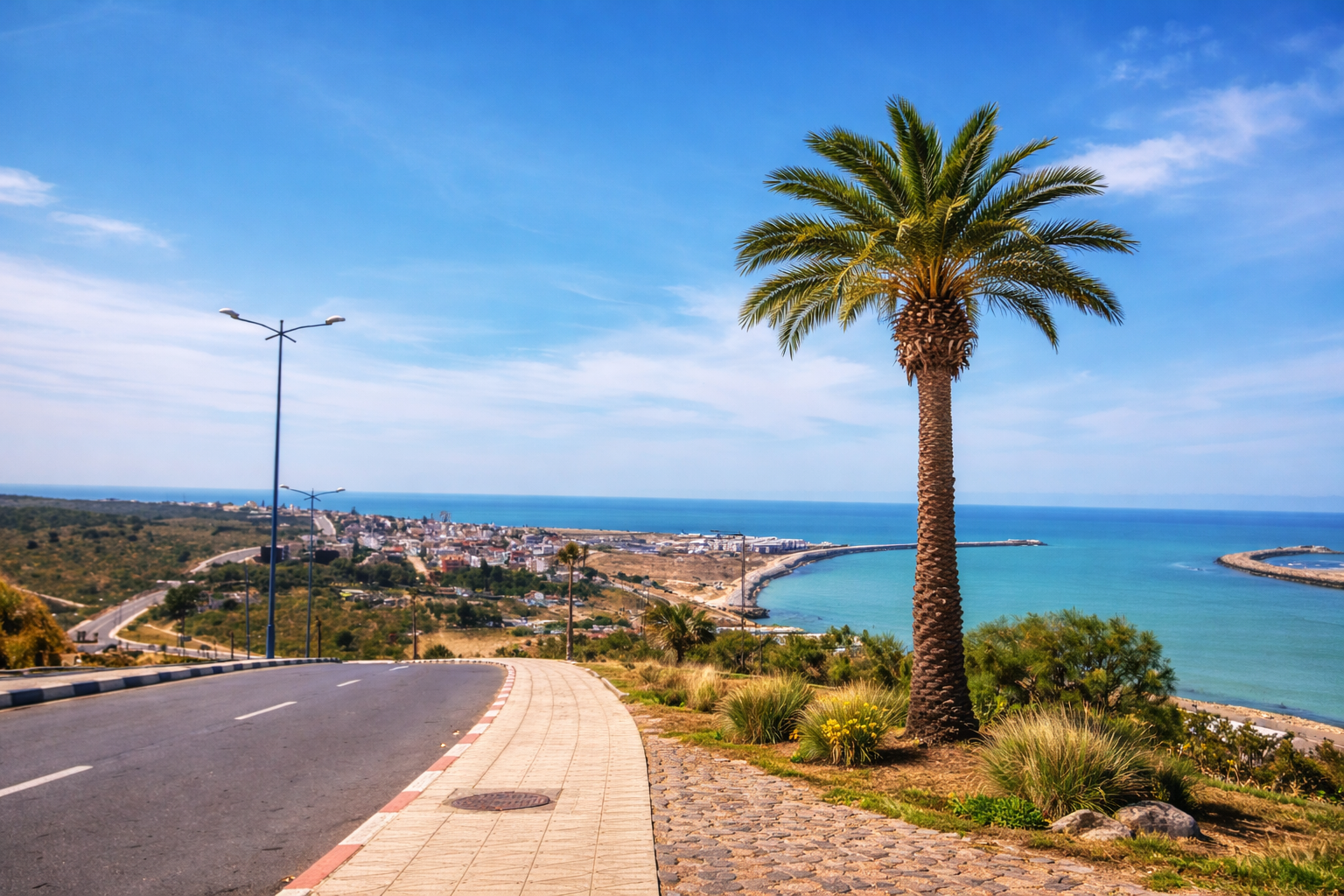
The case for Kénitra can be broken into four clear drivers. First, connectivity keeps the city integrated into the capital corridor rather than isolated from it. Second, employment and business activity create year-round residential need. Third, pricing still allows buyers to access more space or newer product than in stronger-priced neighboring markets. Fourth, the city offers a broader quality-of-life proposition than many buyers initially assume, particularly through its Atlantic edge and access to Mehdiya.
None of these drivers is enough on its own. Their significance comes from their overlap. A city with pricing alone is not necessarily a strong opportunity. A city with infrastructure alone is not necessarily a strong opportunity. Kénitra becomes more compelling because access, demand, and value are reinforcing one another at the same time.
Regional connectivity
High-speed rail and motorway links keep Kénitra inside the operating geography of Rabat-Salé-Kénitra rather than outside it.
Employment-backed demand
Industrial and service activity support residential need tied to working life, suppliers, and household formation.
Price-to-product advantage
Buyers can still access more space, newer stock, or better specifications than in stronger-priced nearby markets.
Additional place value
Mehdiya and the Atlantic edge improve the city's lifestyle proposition without changing its fundamentally practical character.
| Metric | Kénitra | Rabat |
|---|---|---|
| Price per m² | 8,000 – 11,500 MAD/m² | 15,000 – 28,000+ MAD/m² |
| TGV Access | Dedicated TGV station · 5 min from centre ville | Multiple stations · more congested access |
| Beach Proximity | Mehdiya Atlantic beach · 10–15 min | Nearest Atlantic coast · 30–40 min |
| Industrial Demand | Atlantic Free Zone · OCP · major anchors nearby | Administrative capital · limited industrial base |
Who the Market Makes Sense For
Kénitra makes the strongest sense for buyers who are balancing regional access with cost discipline. That includes households priced out of tighter markets, diaspora buyers looking for a rational foothold in the region, and end users who want a practical city with improving relevance rather than a purely prestige location.
It also makes sense for investors and developers who understand that quieter markets can still produce durable demand. In Kénitra, the demand story is not built only on image. It is built on transport, work, and household use. That tends to create a more grounded market base than one driven purely by fashion or tourism.
The current opportunity in Kénitra is straightforward: the city already has the connectivity and demand profile of a relevant regional market, while pricing and visibility have not fully caught up.
Why Timing Matters
The regional search has widened
As pricing pressure increases in stronger-profile markets, more buyers are widening their search area while still prioritizing mobility and infrastructure. That shift directly benefits cities like Kénitra.
Demand is based on use, not only attention
Kénitra's demand profile is supported by households, workers, return buyers, and practical relocations. That gives the market a base beyond short-term visibility.
The visibility gap remains open
In more mature markets, pricing and perception tend to move together. In Kénitra, the perception side still trails the fundamentals. That is one reason the market remains attractive now.
The city offers more than utility alone
Mehdiya and the Atlantic edge matter because they strengthen the city's livability. That does not replace the investment case, but it improves the overall quality of the market proposition.
Conclusion
Kénitra presents an opportunity now because the city already has the underlying conditions of a relevant regional market: strong mobility, employment-backed demand, and a more favorable price-to-product ratio than tighter neighboring locations. The case does not depend on speculation. It depends on existing market conditions.
For buyers and investors, the practical question is whether those conditions justify attention today. In our view, they do. Kénitra is not simply a cheaper alternative. It is a connected market with real demand and a timing advantage that still appears open.